
The serious game «Roots of the People» represents much more than a technological product: it becomes a bridge that connects universities around a common purpose.
In an increasingly interconnected world, universities face the challenge of preparing global citizens capable of recognizing diversity, working in cooperation, and building joint solutions. Within this context, a meaningful experience was developed: the collaborative creation of a serious game (Roots of the People: An Adventure for Inclusion in Latin America) on diversity and inclusion, led by UNIMINUTO and carried out as part of the BeGlobal project under the ERASMUS+ program.
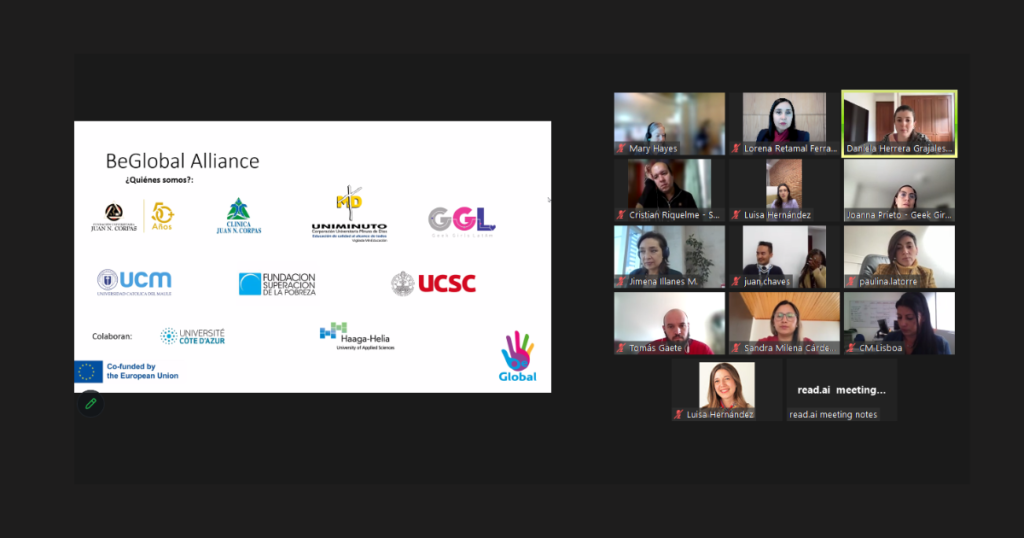
The process took place in four virtual sessions that brought together students and faculty from different higher education institutions. More than just designing a digital resource, the initiative became an exercise in internationalization and academic cooperation, where creativity was put at the service of inclusion.
Characters that Embody Diversity
The starting point was the creation of character sheets. Each participant designed a protagonist with a name, physical characteristics, cultural background, and motivations. In this way, figures with diverse identities emerged: a young woman with hearing impairment facing communication barriers, a student who is the child of migrants dealing with cultural tensions, among others.
These creations were not simple archetypes, but living representations of real issues. By sharing their character sheets, participants engaged in an exercise of empathy that allowed them to understand how differences shape life experiences and, at the same time, enrich social interactions.
Levels and Mini-Games as Spaces for Reflection
The next phase consisted of transferring these characters into playful scenarios. Levels with mini-games were designed in which each figure could act as protagonist, antagonist, or secondary character. This dynamic strengthened the collective narrative and opened spaces for critical dialogue.
For example, one mini-game required ensuring that a character with hearing impairment could participate in a group activity. Another level proposed the collaborative construction of an accessible space, where success depended on cooperation among characters with different abilities. Narrative tensions also emerged in which antagonists reproduced stereotypes and prejudices, sparking debates among participants about the implications of such attitudes.
In this way, the experience went beyond creating a digital product; it allowed students to practically engage with the challenges of inclusion and the need to transform imaginaries.
Shared Learnings
Among the main results, the following stand out:
Broader perspectives: as an interuniversity exercise, each institution (and context) contributed different viewpoints, enriching the construction of characters and narratives.
Empathy and awareness: the character sheets were an effective resource to make realities visible and recognize the richness of differences.
Critical reflection: the presence of antagonists who reproduced prejudices served as a trigger to discuss and re-signify everyday practices.
Networking: virtuality facilitated interaction among students and faculty in different places, demonstrating that internationalization does not rely solely on physical mobility.
Internationalization and Cooperation through Play
This project demonstrated that internationalization can be experienced at home through collaborative practices. By meeting in a virtual space, participants engaged in dialogue with peers from different institutions and contexts, broadening their vision of diversity and inclusion.
The framework of the BeGlobal project under ERASMUS+ gave solidity to the initiative, showing how international cooperation translates into pedagogical projects that combine innovation, creativity, and social commitment. In this case, the serious game Roots of the People represents much more than a technological product: it becomes a bridge that connects universities around a common purpose.
Conclusion
The interuniversity co-creation of a serious game on diversity and inclusion, developed within the framework of the BeGlobal project of ERASMUS+, demonstrates that play is a powerful resource to promote meaningful learning. Virtuality was not a limitation, but an opportunity to strengthen networks, integrate perspectives, and create spaces for intercultural dialogue.
In a global scenario that requires citizens capable of recognizing and valuing difference, this project stands as an example of how academic cooperation and internationalization can be materialized in creative, critical, and transformative practices.